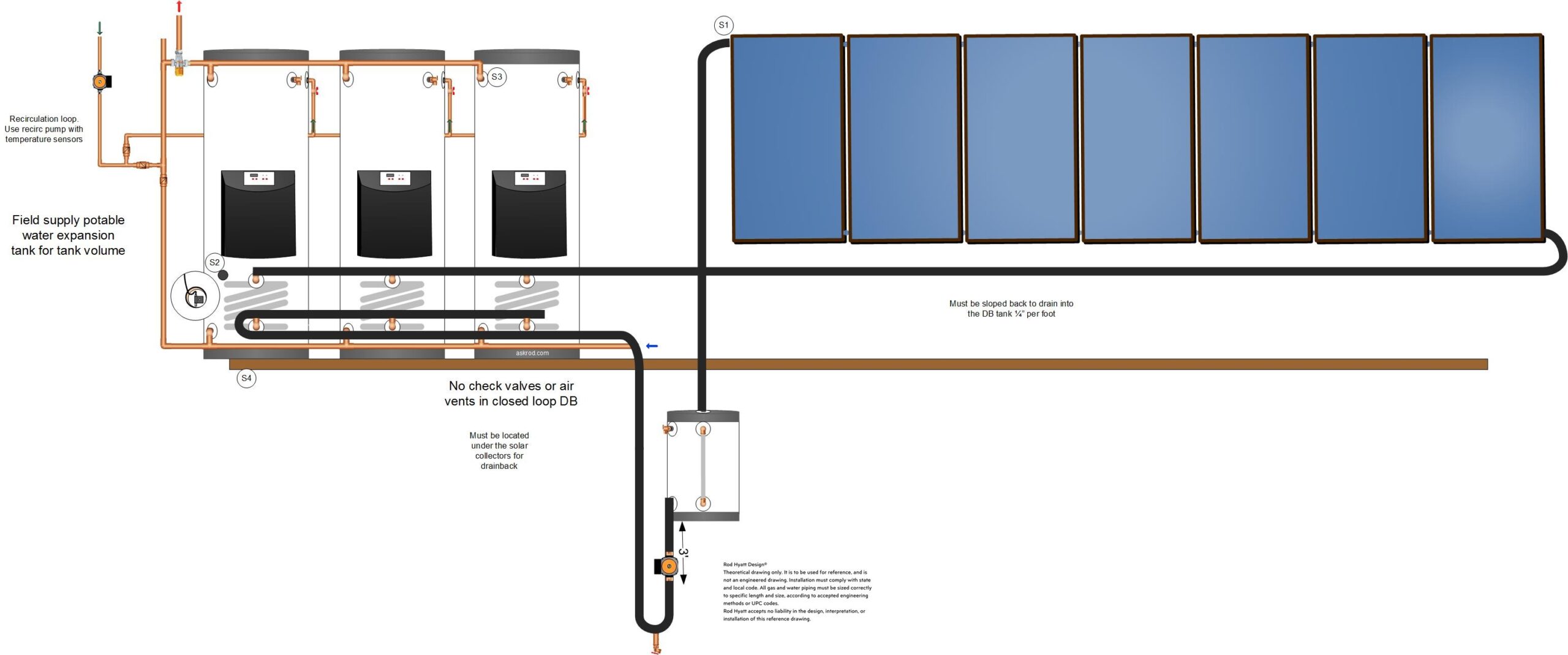

When piping together large commercial solar arrays, there are some basic rules that will make installation flow much more easily. Continue reading
The new solar controls on the market today know how to milk every drop of energy out of a solar collector. No more do you manually turn on a pump when there is more heat in one place then another. Today’s controllers have pump speed control and programming that adjust to most solar systems and … Continue reading
It’s the season to size solar for pools. Here’s the formula to do that for your own swimming hole. Continue reading
As a New Year’s resolution, perhaps we can pledge to get rid of old, energy wasting solar-thermal system designs and instead opt for efficiency and utility, as illustrated in a new system at the Minneapolis-St. Paul International Airport. Continue reading
Solar is basically a low-temperature producer, which makes it perfect for radiant floors and space-heating, which require low temperatures. To store all that solar-heted water, extra large tanks are a good bargain. Continue reading
Sometimes the anti-scalding valve can cause problems with a recirculation loop in a solar thermal system. Here’s how to pipe a mixing valve so the recirc loop always performs. Continue reading
Here’s another example of a medium-sized commercial solar thermal system, this time in warm Florida. This drainback design, for Gulf Coast State College, features eight vacuum-tube collectors and two Solar Phoenixes for backup. Continue reading
We’ve discussed smaller commercial systems; now for something a bit larger, such as a small hotel or school. This post’s design is for an apartment complex in Los Angeles. Continue reading
Looking for a design for a light commercial solar thermal system that actually uses solar energy to heat hot water? Here it is Continue reading
Here’s an easy service tip for those whose systems use an HTP drainback tank – specifically on the maintenance or replacement of the sight glass. Continue reading
By Tom Scheel — The issue of flat-plate collectors vs. evacuated tube collectors may rank among the classic debates — unless you live in Arizona (flat plate) or Vermont (vacuum tube). Here’s an explanation about the differences. Continue reading
Like automobiles, solar thermal designs have become sleeker and more efficient over the decades. You wouldn’t expect today’s performance out of a 1964 Mustang, just like you wouldn’t see high efficiency and lower cost using an outdated solar design. But it’s done all the time. Continue reading
A drainback solar design may be easier and less expensive, but the decision to go with drainback or the more popular pressure-glycol system depends on the building. Continue reading
Bad solar-thermal designs not only cost customers money, but can do permanent damage to the solar industry we all love. Continue reading
1970s-era solar thermal designs are still common, although today’s technology makes solar hot water more efficient and less expensive. Continue reading
Check out the data logs for Rod’s own residential system. Satisfying curiosity is one of the many advantages to tracking your system’s performance. Continue reading
I’m most often asked how to size a solar thermal system: the number of collectors and tank size, for example. Here’s an example of how to design a solar thermal system for a larger project — in this case a college dormatory. Continue reading
In some cases, strengthening your solar collector mounting is necessary to prevent wind damage. When to use extra supports beneath your roof. Continue reading
One of the most penetrating questions of solar thermal is how to attach the solar collectors to the roof. It’s one I get asked quite often: Is it safe to make those holes in my roofing material? There are many ways to ensure a weather-tight seal, whether using a flush-roof mount or an adjustable mount that tilts the … Continue reading
Some solar thermal systems are under performing or simply not working because of improper design or installation. The solution may be to monitor all systems to see just how much non-renewable fuel is being replaced by solar. This will help us catch and diagnose the non-performers early on. Continue reading
Some anti-scalding valves are especially rated for the wide temperature swings that come with solar hot water. Should you always use an anti-scalding valve rated for solar? Here’s a Q and A. Continue reading
When you’re designing a solar system for a large commercial or military lavatory where hot water is used only intermittently, it can be tricky to make the solar count. Should you pre-heat or not? These designs illustrate options of using a mechanical control or using stratification to keep the showers hot. Continue reading